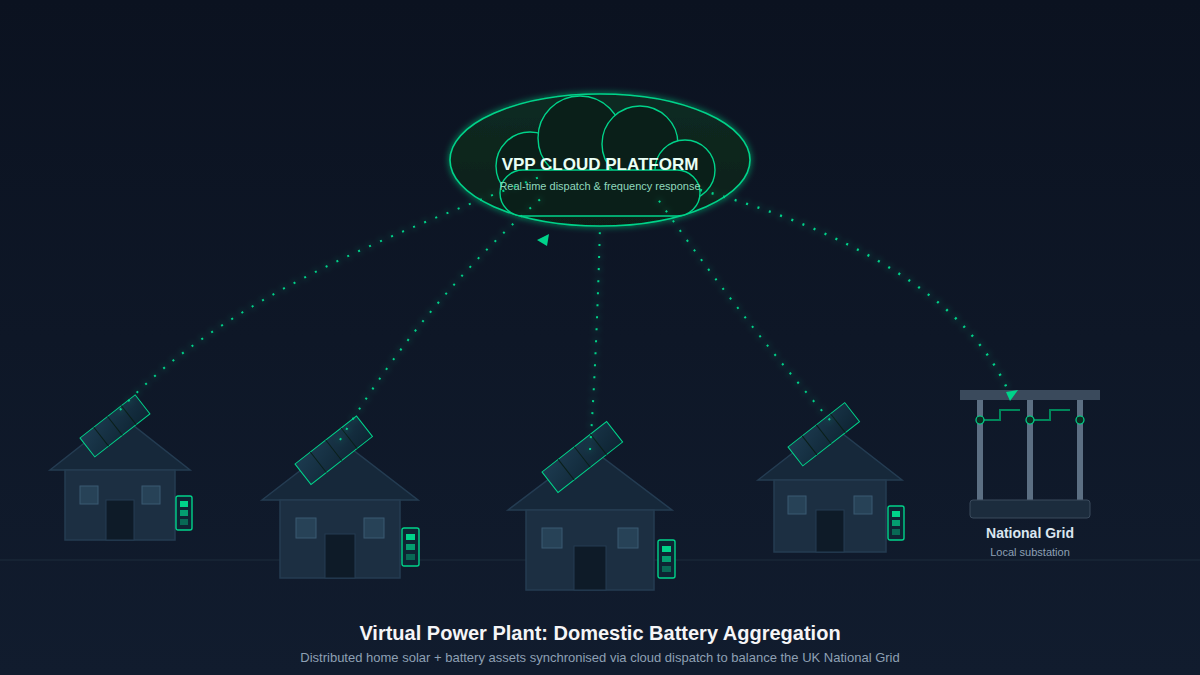
Britain's electricity grid was built around a small number of large, predictable power stations. Today, that model is being quietly rewired from the bottom up. Instead of a handful of gigawatt-scale plants, the grid is increasingly balanced by hundreds of thousands of small, distributed assets — home batteries, solar inverters, EV chargers and smart thermostats — coordinated in real time by cloud software. This aggregated network is called a Virtual Power Plant, and it is now a working part of how National Grid ESO keeps the lights on.
What Is a Virtual Power Plant, Technically?
A VPP is not a physical power station. It is a software layer — typically a cloud-hosted dispatch platform — that holds a live telemetry connection to every enrolled device: a battery's state of charge, its inverter's maximum export rate, its round-trip efficiency, and the household's own consumption pattern. When the grid operator or an energy supplier needs additional capacity, the VPP platform issues a dispatch signal, and every participating battery responds within the same control cycle, together behaving as one large, controllable power station.
- Aggregation: Thousands of sub-5kW batteries are pooled into virtual blocks large enough (typically 1MW or more) to bid into wholesale and balancing markets that were historically only accessible to utility-scale generators.
- Telemetry: Each asset reports state of charge, temperature, cycle count and inverter headroom every few seconds, usually over a secure MQTT or REST connection back to the platform's control layer.
- Dispatch: A central optimisation engine issues charge/discharge instructions to the fleet, weighted by each battery's available capacity, degradation profile and the homeowner's own comfort settings — so no single household is ever drained below its reserved backup threshold.
- Settlement: Energy exported is metered against a calculated baseline and reconciled through the relevant market mechanism, with revenue split between the platform operator and the homeowner, typically as a fixed per-kWh rate or a seasonal bonus payment.
Frequency Response: The Millisecond Layer
The UK grid must be held within a narrow band around 50Hz at all times. A mismatch between generation and demand — a large power station tripping offline, for example — pushes frequency away from that band within seconds, and left uncorrected it can cascade into blackouts. This is the layer where VPPs operate fastest and where the "milliseconds" claim in the definition above is literal, not marketing language.
National Grid ESO procures this correction through services such as Dynamic Containment (DC), split into DC-Low (for over-frequency events) and DC-High (for under-frequency events). Enrolled batteries run a local firmware control loop that watches grid frequency directly at the inverter and begins responding within 1 second of a deviation, reaching full contracted output within 1–10 seconds depending on the service tier — long before a cloud round-trip could ever react in time. The cloud platform's role at this layer is not real-time control but pre-positioning: keeping each battery's state of charge inside the operating band needed to guarantee that local response is available when it's called on.
UK Grid Balancing Hierarchy: Traditional vs VPP Response
| Operational Parameter | Legacy Fossil-Fuel Peaker Plant | Distributed Domestic Battery VPP |
|---|---|---|
| System Response Time | 5–15 minutes (OCGT spin-up) | <1 second (sub-second inverter response) |
| Capital Cost per MW | £400,000–£800,000 | Near-zero incremental cost (assets already owned by consumers) |
| Carbon Footprint (gCO2/kWh) | 400–600 | 0–50 (grid-charged, largely renewable) |
| Local Network Constraints | Centralised, adds transmission loss over distance | Distributed at the point of consumption, reduces local network stress |
| Consumer Monetisation Routes | None — cost is socialised via network charges | Direct payments via DFS, STOR, smart tariffs and export arbitrage |
The Engineering Behind Grid Balancing Services
Two National Grid ESO mechanisms sit behind most UK domestic VPP activity: the Demand Flexibility Service (DFS) and Short Term Operating Reserve (STOR).
Demand Flexibility Service (DFS)
DFS is a day-ahead flexibility market, introduced by National Grid ESO to manage tight winter margins without holding expensive fossil-fuel reserve online "just in case." When ESO forecasts a tight margin between generation and demand — typically a still, cold winter evening with low wind output — it issues a call for flexibility roughly 24 hours in advance, specifying a defined half-hour or one-hour window along with a target volume in MW. Aggregators and suppliers running VPP platforms then bid a volume of demand reduction or battery discharge into that window at a clearing price, competing against other providers in the same auction.
When the event is confirmed, every enrolled household's battery or smart appliance is automatically instructed to discharge or reduce load for the contracted window. Actual delivery is verified against a calculated baseline — typically the average of a household's consumption over several comparable recent days — and any shortfall against the committed volume is penalised, which is why aggregators deliberately over-enrol batteries relative to their contracted MW to build in a safety margin.
Short Term Operating Reserve (STOR)
STOR is a faster, contracted balancing service that predates DFS and operates year-round rather than only during winter stress events. Providers commit to delivering a specified MW of output within 20 minutes of instruction and sustaining it for at least two hours, available to the ESO's control room around the clock via a standing contract rather than a day-ahead auction. For a VPP operator, this means maintaining a reserved buffer of charge across the aggregated battery fleet at all times — batteries can never be allowed to run flat, because the platform must be able to guarantee the contracted volume regardless of individual households' day-to-day usage patterns. This is typically achieved by ring-fencing a minimum state-of-charge threshold per battery that ordinary home consumption is not permitted to draw below.
How Octopus Saving Sessions Turns Batteries Into Revenue
Octopus Energy's Saving Sessions is the best-known consumer-facing example of this mechanism in action. The process runs in four stages:
- Forecast: Octopus identifies an upcoming period of grid stress and notifies enrolled customers of a fixed 30–60 minute window, usually with a day or more notice.
- Baseline: Each household's normal consumption for that time slot is calculated from historical smart meter data.
- Response: Customers reduce grid import — either manually or automatically, if they have a compatible battery or EV charger connected via the Kraken platform — by drawing on stored battery power instead.
- Payment: Verified reduction below baseline is paid per kWh, credited directly to the customer's account, typically within a few days of the session.
Automated smart-tariff events work on the same underlying logic but continuously: agile import/export tariffs shift a battery's charge and discharge schedule to track wholesale price signals, so the household is effectively running micro-STOR-style arbitrage every day rather than only during flagged events.
What a Household Needs to Actually Participate
Joining a VPP is a software enrolment on top of hardware most solar-and-battery households already own, rather than a separate installation project:
- A compatible battery and inverter: Systems such as GivEnergy, Tesla Powerwall, and other major UK-approved battery brands ship with the remote-control API access a VPP platform needs to issue dispatch instructions.
- A smart meter (SMETS2): Required for half-hourly settlement data, which is how DFS and Saving Sessions events verify a household's baseline and measured reduction.
- An aggregator or supplier account: Either a smart tariff from a supplier running its own VPP (such as Octopus's Kraken platform) or a standalone aggregator that pairs with the homeowner's existing electricity contract.
- Consent to remote dispatch: Homeowners set a minimum reserve — the battery capacity that stays protected for the household's own backup use — and the platform is contractually restricted from dispatching below it.
Why This Matters for the Grid
Every domestic battery enrolled in a VPP reduces the system's reliance on fossil-fuel peaker plants that would otherwise be held in reserve for exactly these moments of tight margin. As battery and solar adoption grows across UK housing stock, the aggregate capacity available to ESO through VPP platforms continues to scale — without a single new power station being built.