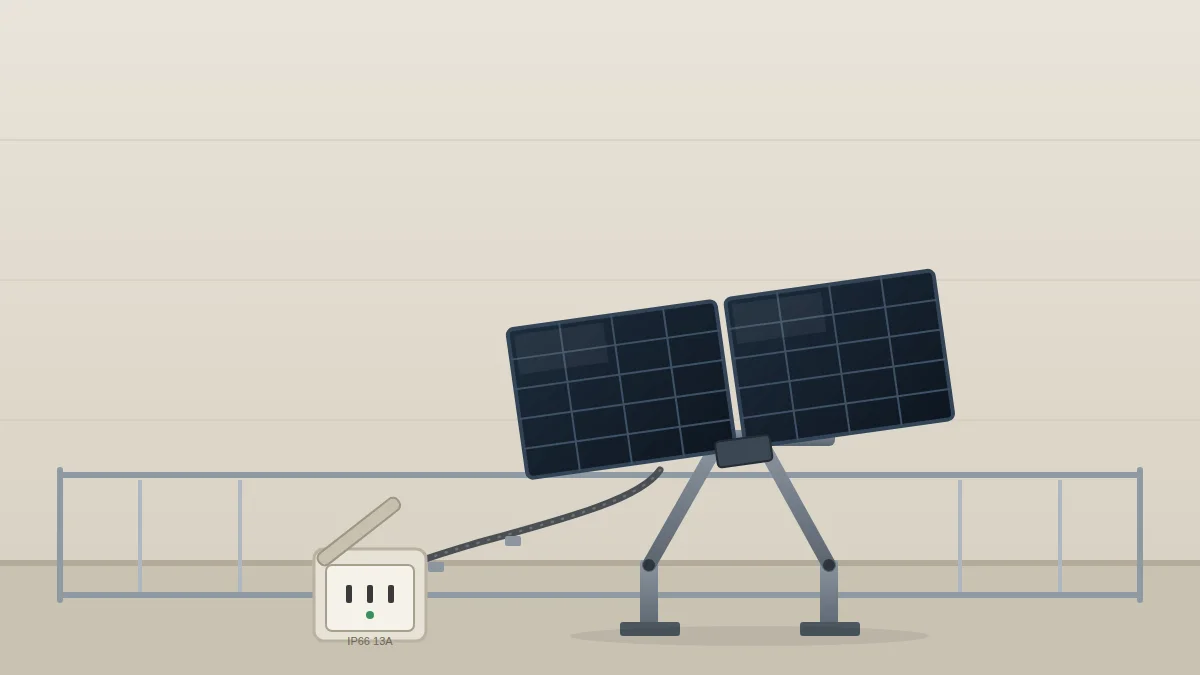
From today, plug-in solar is no longer a legal grey area in Great Britain. Two pieces of regulation moved in step: BS 7671 Amendment 4, published on 15 April 2026, created a new Section 745 covering microgeneration up to 800W, and SI 2026/848 — formally The Plugs and Sockets etc. (Safety) Regulations 1994 and Electricity Safety, Quality and Continuity Regulations 2002 (Amendment) Regulations 2026 — came into force on 27 August 2026. SI 2026/848 is the specific instrument that permits a notified body to approve a standard plug for a microgenerator, and bars such a device from being installed or operated unless it meets the government's Plug-in Solar Device Interim Product Specification (v2).
In practice, that means the kit sitting in an Amazon warehouse is not automatically legal. It only becomes legal to self-install the moment its specific micro-inverter model appears on the ENA G98 Type Test Register. If the model isn't listed, plugging it in is unlawful regardless of its wattage.
What Actually Changed on 27 August 2026
- A certified plug-in solar device can now be connected to an unmodified, standard UK 13A socket — no consumer unit work and no registered electrician required for the connection itself.
- England also gained a Permitted Development Right for houses covering plug-in solar mounting, removing the need for planning permission in most cases.
- Every device must still be notified to the local Distribution Network Operator (DNO) under the G98 process after it's plugged in.
- The Amendment 4 Section 745 hardwired route (installed by a registered electrician) still exists in parallel, for households who want a permanent circuit rather than a portable plug-in unit.
How a Compliant Install Actually Works
Because there's no consumer unit work involved, the physical installation is closer to mounting a satellite dish than wiring a circuit. The compliant sequence looks like this:
- Buy a complete kit — panels, cable and micro-inverter sold together as one certified unit, not assembled from separate parts
- Check the inverter model against the live ENA G98 Type Test Register before opening the box
- Fix the bracket or ground stand to a compliant surface, ruling out timber and cladding as covered below
- Route the factory-supplied cable directly to a dedicated, weatherproof outdoor 13A socket — no extensions
- Energise the system and submit your G98 notification to your DNO
The UK Plug-In Solar Compliance Framework
| Variable | Rule Under SI 2026/848 |
|---|---|
| Maximum AC Output | 800VA (3.5A) at the micro-inverter/plug — this is the figure the "800W" shorthand refers to |
| Maximum DC Panel Capacity | 2,000W combined, across a maximum of four modules, no more than two wired in series |
| Battery Storage Integration | Not permitted — the Interim Product Specification explicitly excludes import/storage devices from this amendment |
| Extension Lead / Adaptor Usage | Prohibited — the unit must plug directly into a fixed, dedicated 13A socket outlet |
| DNO Notification Mandate | Mandatory G98 notification to your local network operator once the device is connected |
| Permitted Development Cladding Restrictions | Banned on ACM/MCM, HPL or timber cladding systems, timber balconies, and any building under external wall fire remediation |
Anti-Islanding: Why the Plug Itself Is the Safety Device
The single non-negotiable engineering requirement behind SI 2026/848 is anti-islanding protection. A grid-tied inverter normally synchronises its output to the grid's own voltage and frequency. If the supply is cut — a DNO working on the local network, a blown fuse, or someone simply pulling the plug — a poorly designed inverter could keep exporting current into what it "thinks" is still a live circuit. That's called islanding, and it's exactly why generic camping or hobbyist solar kits were never legal to plug in: the two 13A pins on the flex could stay energised after being pulled from the socket, creating a shock risk for anyone who touches them.
A certified device on the G98 register must detect loss of the grid reference signal and de-energise its output within milliseconds — effectively instantaneously relative to human reaction time. This is what the Interim Product Specification is actually certifying: not the panels, but the inverter's ability to go completely dead the moment it's disconnected, whether that disconnection is a fault or just someone unplugging it to take the kit indoors.
Why Timber Balconies and Remediation Buildings Are Banned
The cladding restrictions in the table above aren't bureaucratic overreach — they trace directly to post-Grenfell external wall fire safety policy. The Interim Product Specification bans fixing brackets or panels to:
- Aluminium composite material (ACM) or metal composite material (MCM) cladding systems
- High-pressure laminate (HPL) cladding systems
- Timber cladding systems and timber-decked balconies
- Any building currently subject to external wall or building-safety remediation works
The concern is twofold: a mounting bracket penetrates the cladding's fire-stopping detail, and a hot micro-inverter or a fault-condition arc sitting against combustible material is a direct ignition risk on exactly the building types where a fire can travel fastest. There is a practical way around this restriction that many installers don't mention: ground-mounting the panels in a garden, on a metal stand rather than a wall bracket, sidesteps the building-fabric rules entirely — provided a standard outdoor socket is within reach of the kit's factory-supplied cable.
The Base Load Strategy: What an 800W Kit Can Actually Offset
An 800W plug-in system will not run a kettle or an oven, and on a dull British afternoon it may generate closer to 150–300W. The engineering logic that makes it worthwhile anyway is called the base load strategy. Every home has a floor of always-on background demand — a fridge-freezer, a Wi-Fi router, a broadband modem, standby electronics, a smart speaker — that typically draws somewhere between 150W and 400W continuously, day and night. A plug-in solar system is deliberately sized to sit at or just above that floor.
Because the inverter is grid-following rather than battery-backed, it can only offset demand that's happening in the same instant the sun is producing. It cannot export surplus for credit and cannot store anything for the evening — the moment generation exceeds what your background appliances are drawing, the excess is simply lost. That's precisely why sizing the system to your base load, rather than your peak load, is the only strategy that captures real savings: during daylight hours, the panels quietly cancel out the fridge and router's draw from the meter, and the rest of the day proceeds exactly as before.
Why Batteries Are Still Banned Under This Amendment
It's worth being precise about scope: SI 2026/848 legalises plug-in generation, not plug-in storage. The Interim Product Specification explicitly excludes any device capable of importing and storing grid electricity. A battery adds import current, charge/discharge switching and standing energy behind a domestic 13A plug — a fundamentally different (and currently uncertified) risk profile from a panel that only ever pushes a small, anti-islanding-protected export. Manufacturers are expected to seek certification for plug-in battery add-ons later, but as of today, connecting one is outside what the law permits.
Realistic Costs and Savings
Compliant 800W kits are typically priced in the low-to-mid hundreds of pounds once the certified micro-inverter and outdoor-rated cabling are included — expect to pay more than an equivalent uncertified panel-and-inverter set imported without G98 registration. Because the system offsets base load rather than exporting for payment, savings scale with how much of your daily background draw falls during daylight hours: a household with a router, fridge-freezer and networked devices running continuously can realistically offset a meaningful share of that floor consumption across spring and summer, with far less contribution during short winter days. There is no export income, since anti-islanding and the 800VA cap are designed around self-consumption, not grid sale.
Frequently Asked Questions
Do I need an electrician at all? No, provided the kit is G98-listed and plugs into an existing, unmodified 13A socket. An electrician is only required if you choose the separate BS 7671 Amendment 4 hardwired route instead.
Can I add more than one plug-in unit? Guidance published alongside SI 2026/848 points to one registered device per household connection, reflecting the single G98 notification model — check with your DNO before adding a second unit.
What happens if my inverter isn't on the G98 register? It is unlawful to energise it. Unlisted devices fall outside the Interim Product Specification entirely, regardless of their advertised wattage.
Before You Buy: The Compliance Checklist
- Confirm the exact model of micro-inverter is listed on the ENA G98 Type Test Register — not just the panel brand
- Check the combined DC panel rating doesn't exceed 2,000W across a maximum of four modules
- Never use an extension lead or multi-socket adaptor — plug directly into a dedicated, fixed outdoor socket
- Rule out timber balconies, ACM/MCM/HPL cladding, and any remediation-affected building before mounting
- Submit your G98 DNO notification as soon as the device is connected
- If your building fails the cladding check, consider a ground-mounted garden stand instead
SI 2026/848 closes a gap that had left thousands of UK households buying plug-in kits that were technically illegal to energise. The rules are narrow by design — capped output, no batteries, no extension leads, tight fire-safety exclusions — but for a compliant, G98-listed kit sized to your fridge and router rather than your whole house, they now offer a genuinely straightforward, self-install route to cutting the base load on your electricity bill.