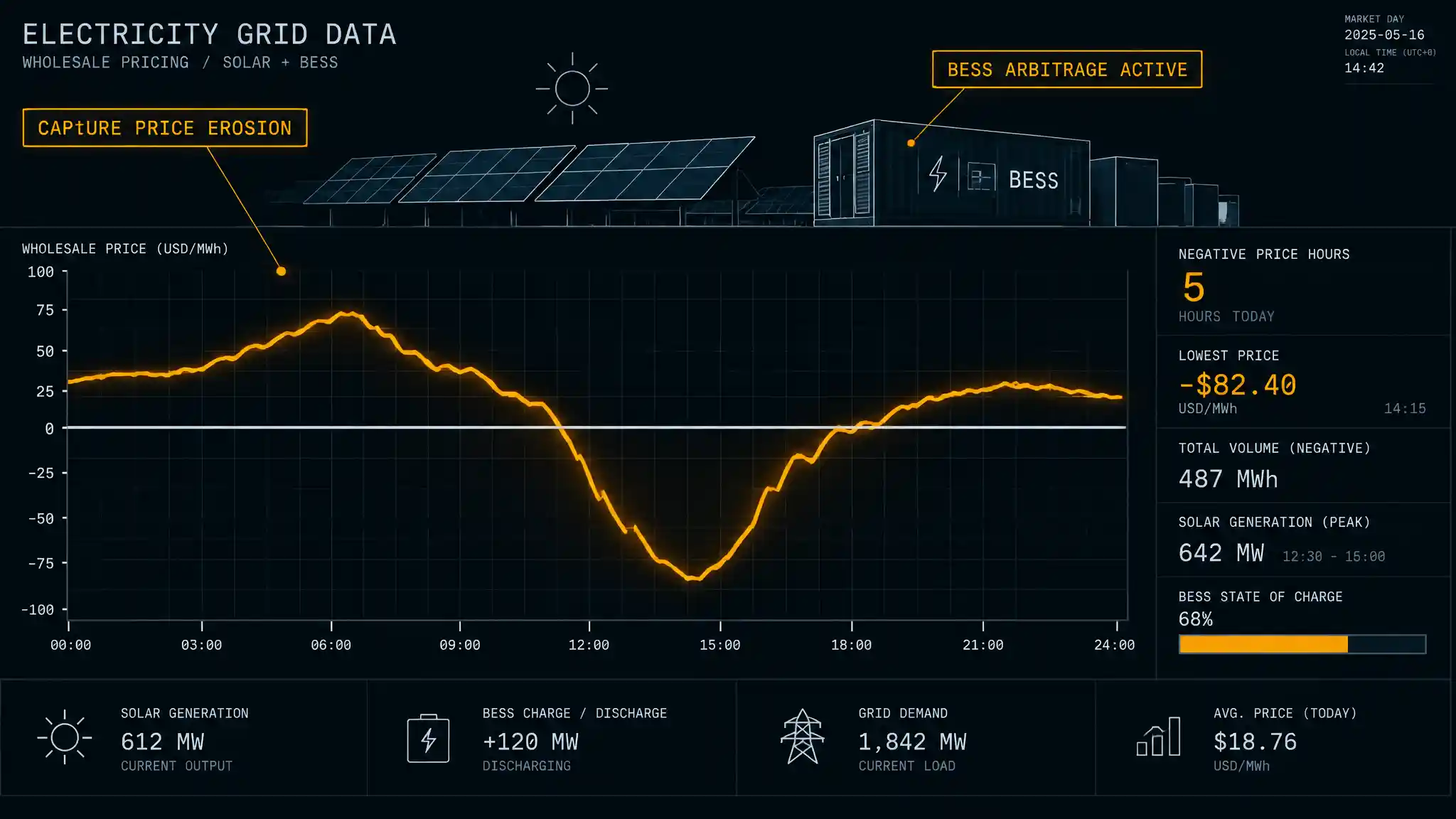
The Mechanics of Generation Cannibalisation
Solar's marginal cost of generation is close to zero. In the merit order — the mechanism that stacks generation bids from cheapest to most expensive and clears the market where supply meets demand — that puts solar at the very bottom of the stack, first to be accepted and last to be turned away.
The problem is correlation, not capacity. Irradiance doesn't vary asset by asset across a region; it varies hour by hour, uniformly. Every solar array on a shared network floods the grid at the same clearing hour, not a spread of hours a merit-order model can smooth out. Supply overshoots demand at that single price point, and the wholesale spot price collapses toward £0/MWh, or below it, as generators locked into must-run and subsidy-linked positions keep exporting rather than absorb a costly shutdown-restart cycle.
This is price cannibalisation, named precisely: as solar capacity scales, the price solar itself captures during its own generating hours falls, in proportion to how much more solar just came online. The asset's revenue erodes fastest exactly when its output peaks.
Legacy power purchase agreements were never priced for this. A flat-rate PPA assumes a stable, predictable capture price — the volume-weighted average price an asset actually realises across its output. Cannibalisation drives a wedge between that assumption and reality: as solar penetration rises, a solar asset's real capture price falls below the wider system average price, and keeps falling, because its own output and the market's lowest-price hours are now the same hours. That wedge is pure merchant risk, sitting entirely with the generator, not the off-taker.
The Balancing Mechanism and Grid Volatility
National Grid ESO's job is narrower than price: hold system frequency inside its statutory band, regardless of what the market is doing. When solar supply overshoots demand hard enough to threaten that boundary, ESO has two levers, and both cost the generator money.
The first lever is curtailment: an explicit instruction to reduce or stop output. For a merchant asset without a Contract for Difference underpinning it, curtailment isn't neutral — it's lost revenue on every curtailed megawatt-hour, with no guaranteed constraint payment to offset it, plus additional inverter wear from the resulting start-stop cycling.
The second lever runs through the Balancing Mechanism itself: ESO's real-time dispatch market, where generators submit bids to reduce output and offers to increase it. On an oversupplied afternoon, a generator may accept a negative bid price simply to keep exporting rather than shut down and restart later — effectively paying the system to take electricity it cannot otherwise sell. Either lever, curtailment or a negative BM bid, is the same underlying signal: too much correlated solar, hitting the network in the same hour, with nowhere for the surplus to go.
The Co-Located Storage Solution
Neither lever fixes the correlation problem. Storage does, by decoupling when a solar asset generates from when it sells.
The operational shift is structural: independent solar arrays are being retrofitted with co-located Lithium-Iron Phosphate (LFP) or Sodium-Ion battery energy storage systems (BESS), sited behind the same grid connection point rather than as a separate merchant asset. Instead of exporting into a negative-priced afternoon, the array charges the co-located BESS; instead of losing that energy to curtailment, the operator banks it for a price regime that actually pays.
The math is straightforward once the physics are priced in. Round-trip efficiency on a modern BESS sits in the low-to-mid 80% range — inverter conversion losses, transformer core losses, and auxiliary cooling load all take a cut before a single stored megawatt-hour reaches the grid again. Take a representative negative-price afternoon: the array is paid £20/MWh to keep exporting rather than shut down, a cost the co-located BESS avoids entirely by charging instead. At 82% round-trip efficiency, that 1 MWh returns 0.82 MWh on discharge. Sell that 0.82 MWh into the 16:00–19:00 evening demand peak at a representative £120/MWh, and the trade nets roughly £118 per MWh cycled — a spread no flat-rate PPA was ever priced to capture, and one no merchant solar asset can reach without storage sitting behind its own meter.
That spread is not guaranteed income; it compresses as more storage enters the same arbitrage window, the same crowding effect already reshaping grid-scale BESS economics. Our grid-scale battery arbitrage economics report breaks down the fuller revenue stack — wholesale arbitrage, Balancing Mechanism dispatch, ancillary services — and the degradation cost of cycling hard enough to chase it.
Cross-Linking & Directory Calls
Cannibalisation is not a solar-specific failure. It is what happens whenever a low-marginal-cost, weather-correlated asset class scales faster than the demand window it feeds. The fix, at every scale, is the same: decouple generation timing from sale timing with storage sited as close to the meter as possible.
That logic isn't unique to grid-scale assets. The same charge-low, discharge-high arbitrage this article prices at wholesale level is exactly what a domestic time-of-use battery does behind a household meter — see our home battery tariff-arbitrage framework for the household-scale version of this same trade.